

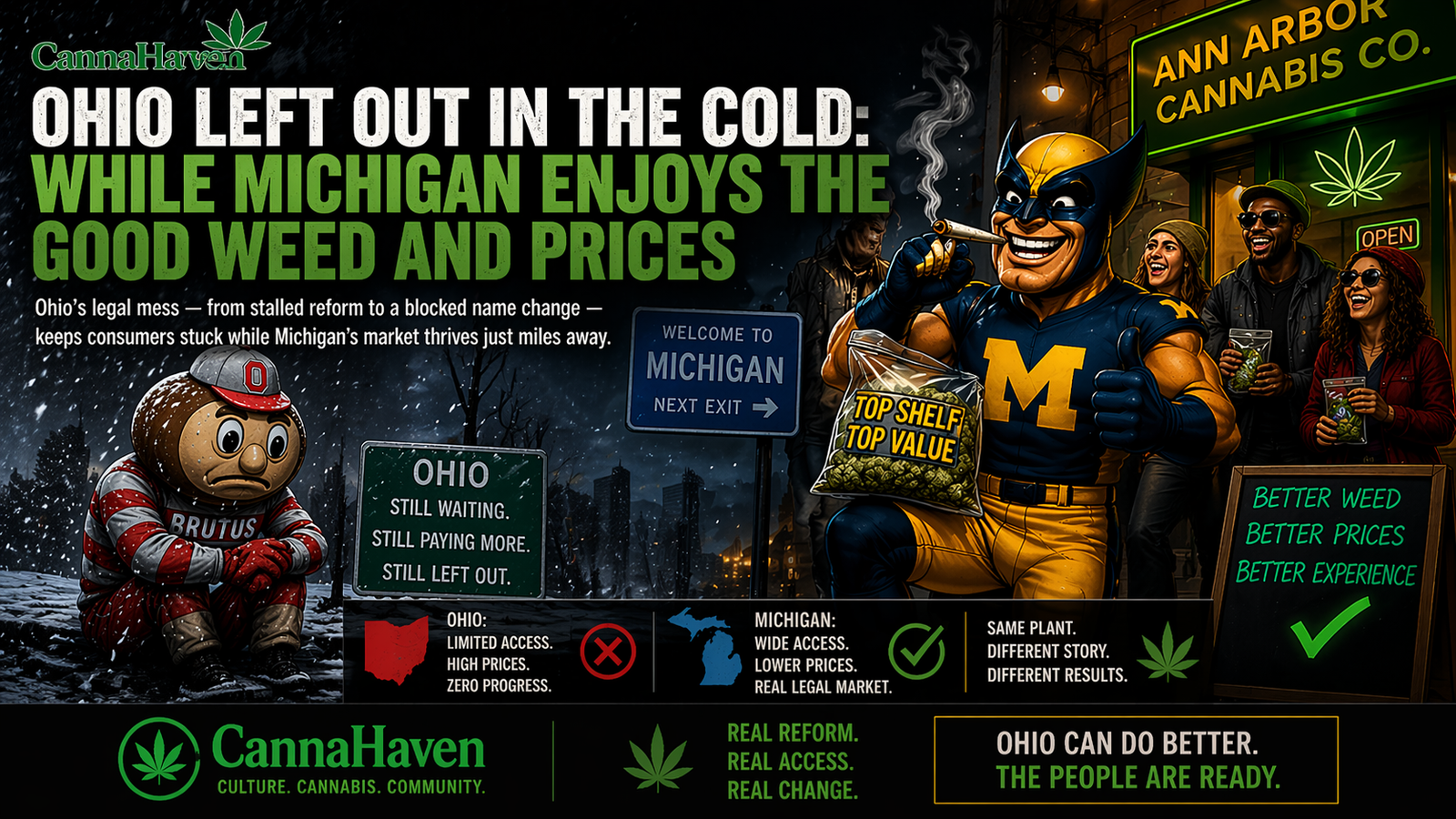
Just a few miles separate Ohio from one of the most successful cannabis markets in the country. But somehow, it feels like a completely different universe.
On one side of the border, Michigan has built a fully functioning cannabis ecosystem where dispensaries are easy to find, prices are competitive, and consumers actually feel like the system was designed with them in mind. On the other side, Ohio remains stuck in a loop of partial progress, stalled decisions, and policies that haven’t quite caught up to the reality on the ground.
For Ohio consumers, that gap is more than political — it’s practical. People looking for quality cannabis at reasonable prices are still running into dead ends at home, while just up the road, Michigan continues to refine a market that delivers more access, better products, and a smoother overall experience. The difference isn’t subtle. It shows up in pricing, availability, and the simple fact that one state treats cannabis like a legitimate industry while the other still treats it like a debate.
That contrast has only grown sharper as Ohio lawmakers wrestle with how to shape their own cannabis framework. One recent flashpoint came with a proposal to replace the word “marijuana” with “cannabis” in state law — a move supporters argued would modernize language and better reflect the plant’s scientific identity. On paper, it sounded like a small, almost symbolic update. In practice, it became another example of how even minor changes in Ohio’s cannabis policy seem to get stuck in the mud.
The proposal ultimately didn’t move forward, leaving Ohio exactly where it’s been: not moving forward, not moving backward, just hovering in place while neighboring states keep building. And that’s the part that stands out most. This isn’t a situation where Ohio lacks demand or interest. The demand is obvious. The consumers are there. What’s missing is a system that meets them where they are.
Meanwhile, Michigan isn’t waiting on perfect language or endless revisions. The state has leaned into building a real market, and the results speak for themselves. Dispensaries are widespread, the quality is consistent, and the pricing reflects actual competition. Tax revenue is flowing, businesses are operating openly, and consumers are no longer forced to look elsewhere for something that can be handled locally.
Ohio’s position, by comparison, feels increasingly difficult to justify. The longer the state takes to fully establish its market, the more normalized it becomes for residents to simply go somewhere else. And when consumers get used to better prices, better access, and a better experience, it becomes harder to pull them back.
At a certain point, the conversation stops being about potential and starts being about reality. Ohio has the population, the interest, and the proximity to one of the best case studies in the country. What it doesn’t have — at least not yet — is the execution.
Until that changes, the dynamic remains the same. Michigan continues to move forward, building on what already works, while Ohio watches from just across the border, close enough to see it all, but not quite part of it.